 Equip-Link
Equip-Link
Equip-Link
Choosing a reliable China 25G SFP28 transceiver supplier requires more than comparing online prices. Network planners must examine optical reach, wavelength options, connector quality, and compatibility with switches from different brands. A low quotation can hide weaker testing or inconsistent production.
This guide introduces leading Chinese suppliers serving data centers, telecom networks, and enterprise infrastructure projects. It considers manufacturing experience, product certifications, quality-control procedures, customization capacity, and export support. Evidence matters. Look for documented test reports, clear datasheets, traceable serial numbers, and responsive technical teams. A supplier should explain whether each 25G SFP28 transceiver supports SR, LR, ER, or other application requirements.
Real purchasing decisions also involve practical details. Ask about sample availability, minimum order quantities, delivery schedules, warranty terms, and firmware coding. A sample that performs well on a bench may behave differently in a crowded rack. That small risk deserves attention.
Supplier rankings are not permanent. Production lines change, engineers move, and support quality can vary between projects. This list should therefore guide evaluation, not replace independent verification. We may overlook smaller manufacturers with strong regional service. That is a limitation worth admitting.
By comparing technical capability with communication quality, buyers can reduce compatibility problems and unexpected replacement costs. The best supplier is not always the cheapest. It is the partner that provides stable optics, honest specifications, and dependable support after shipment. Ask precise questions. Test before scaling.
What Is a 25G SFP28 Transceiver?
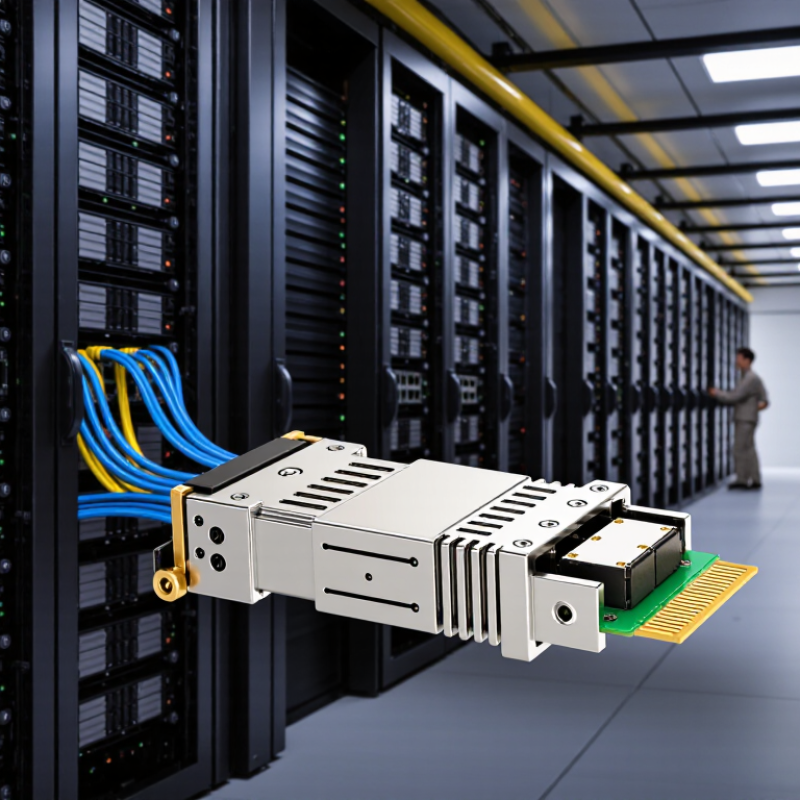
A 25G SFP28 transceiver is a compact, hot-pluggable optical module for 25-gigabit Ethernet links. It usually connects servers, switches, and storage systems through SFP28 ports. SFP28 has a similar physical size to SFP+, but its electrical interface supports higher throughput. One lane carries 25.78125 gigabaud under the 25G Ethernet standard.
It is not simply a faster 10G module. The transceiver includes a transmitter, receiver, optical engine, and monitoring functions. Common versions support multimode fiber for short data-center links or single-mode fiber for longer connections. Reach may range from 70 meters to 10 kilometers, depending on fiber type and module specification. Digital monitoring can report temperature, voltage, bias current, and optical power. Useful details, not decoration.
The Ethernet Alliance’s 25G and 100G Ethernet materials identify 25G as a practical server-connectivity step toward 100G uplinks. Dell’Oro Group’s data-center switch research also shows continuing demand for higher-speed connections as AI, cloud, and storage traffic expand. Yet these figures describe market direction, not every installation. This matters. A 25G module still requires compatible switch firmware, fiber, polarity, and optical budgets. A 10-kilometer rating may fail with poor connectors or excessive loss. Procurement teams comparing suppliers should request test reports, interoperability records, temperature ratings, and clear coding policies. Specification sheets can look perfect. Field performance is less forgiving.
| Evaluation Dimension | Typical 25G SFP28 Specification | Technical Meaning | Procurement Considerations |
|---|---|---|---|
| Definition | Hot-pluggable SFP28 optical transceiver for 25Gb/s Ethernet | Converts electrical signals from a network device into optical signals and converts received optical signals back into electrical signals. | Confirm that the network switch, server adapter, or router supports 25GbE SFP28 modules. |
| Form Factor | SFP28, commonly called a small form-factor pluggable 28G module | Uses the SFP28 cage and connector format and is generally more compact than QSFP28-based 100GbE solutions. | Check cage clearance, connector type, port coding, and host-device compatibility before ordering. |
| Ethernet Data Rate | 25.78125 GBd line rate for 25GbE applications is commonly used | The optical module is designed for approximately 25Gb/s Ethernet traffic, with the exact host interface depending on the equipment. | Do not assume that a 10G SFP+ port or a 100G QSFP28 port will support an SFP28 module without documented compatibility. |
| Common Standards | IEEE 802.3by for 25GbE; SFF-8472 and SFF-8636-related management practices may apply | Standards define Ethernet operation, mechanical characteristics, electrical interfaces, and digital monitoring functions. | Request a current datasheet and compliance statement for the exact optical variant. |
| Short-Reach Multimode | 850 nm, duplex multimode fiber, typically up to 70 m on OM3 and up to 100 m on OM4 | Designed for short-distance data-center connections using parallel or duplex multimode infrastructure, depending on the module design. | Verify whether the module uses duplex LC or another connector and match it with the installed fiber type. |
| Single-Mode 10 km | 1310 nm, duplex single-mode fiber, up to 10 km | Uses a 1310 nm optical design for campus, data-center interconnect, and metropolitan links within the specified distance budget. | Confirm transmit power, receiver sensitivity, optical budget, and connector polish requirements. |
| Single-Mode Extended Reach | 1310 nm or 1550 nm variants may support 20 km, 30 km, or longer distances depending on the design | Longer-reach modules use different optical power and receiver specifications and must be selected according to the link budget. | Never select by distance alone; calculate fiber attenuation, connector loss, splice loss, and dispersion margin. |
| Fiber Interface | Usually duplex LC for 25GBASE-SR and 25GBASE-LR modules | The interface determines how the transceiver connects to the optical patch cord and fiber plant. | Match LC, MPO, or other connector requirements; verify polarity for duplex and parallel-fiber links. |
| Wavelength | 850 nm for multimode; 1310 nm is common for 10 km single-mode links; 1550 nm is used for selected extended-reach designs | Wavelength affects fiber compatibility, transmission distance, optical budget, and the matching transceiver at the opposite end. | Use matching wavelength and reach specifications at both ends of a conventional duplex link. |
| Digital Diagnostic Monitoring | Often provides temperature, supply voltage, laser bias current, transmit power, and receive power readings | DDM or DOM helps monitor optical and electrical operating conditions in real time. | Check whether the host platform can read the monitoring data and whether alarm thresholds are documented. |
| Operating Temperature | Commercial: 0°C to 70°C; industrial options may cover approximately -40°C to 85°C | The temperature grade indicates the environmental range in which the module is specified to operate. | Choose industrial-temperature modules for outdoor cabinets, transport systems, or uncontrolled environments. |
| Power Consumption | Commonly below 1.5 W for many 25G SFP28 optical modules; exact values vary by reach and optical design | Power affects switch thermal load, port density, energy efficiency, and cooling requirements. | Use the maximum rated power, rather than the typical value, when planning system thermal capacity. |
| Host Compatibility | Depends on port speed support, firmware policy, EEPROM coding, FEC configuration, and vendor interoperability | A physically compatible module may not become operational if the host device restricts supported transceiver identification or link settings. | Provide the exact host equipment model and software version when requesting compatibility confirmation. |
| Quality Verification | Recommended checks include optical output, receiver sensitivity, bit-error rate, temperature, power, and interoperability | Testing confirms that the module meets its optical, electrical, and environmental specifications. | Request test reports, serial-number traceability, inspection records, and a defined replacement or warranty process. |
| Supplier Selection Criteria | Technical documentation, production consistency, customization capability, lead time, testing, warranty, and export support | A suitable supplier should be able to provide repeatable performance and technical support across the required product variants. | Compare documented specifications and sample-test results instead of relying only on price or stated transmission distance. |
| Typical Applications | Server connectivity, data-center leaf-spine networks, storage networks, campus networks, and 25GbE uplinks | 25G SFP28 provides higher port bandwidth than 10GbE while maintaining a compact, single-port pluggable form factor. | Select the optical type based on rack layout, fiber infrastructure, required distance, redundancy, and future network expansion. |
It is a compact, hot-pluggable module for 25-gigabit Ethernet connections. It commonly links servers, switches, and storage systems.
No. It includes a transmitter, receiver, optical engine, and monitoring functions. Its electrical interface supports higher throughput.
Short data-center links usually use multimode fiber. Longer connections generally use single-mode fiber.
Reach depends on the module and fiber. Common specifications range from about 70 meters to 10 kilometers.
Digital monitoring can report temperature, voltage, bias current, and optical power. These readings help identify unstable conditions.
Check wavelength, distance, fiber type, connector, temperature rating, polarity, and optical budget. Compatibility matters more than a low quotation.
Request optical test records, receiver sensitivity, bit-error-rate results, temperature data, and interoperability evidence. Clear coding policies are also useful.
Ask about chipset sourcing, assembly locations, production capacity, traceability, and failure analysis. Request samples from multiple production batches.
No. It supports quality management, but it does not prove receiver margins or long-term optical stability. Independent testing remains valuable.
A module may look perfect on paper but behave differently in a real switch. Test temperature, DOM readings, link stability, and error rates for several hours.
A 25G SFP28 transceiver is a compact, hot-swappable optical module designed to support 25Gbps data transmission in data centers, enterprise networks, and high-performance computing environments. When evaluating China-based suppliers, buyers should consider manufacturing capability, product consistency, optical performance, certifications, customization options, delivery reliability, and technical support. A dependable supplier should provide clear product documentation, transparent testing procedures, and responsive communication throughout the purchasing process.
Common product considerations include transmission distance, wavelength, connector type, single-mode or multimode fiber compatibility, operating temperature, digital diagnostic monitoring, and support for relevant network equipment. Before placing an order, customers should confirm interoperability with switches, servers, and cabling systems, while requesting samples or test reports when appropriate. Quality testing may include optical power, sensitivity, temperature stability, and data transmission performance checks. Strong after-sales support, warranty terms, replacement procedures, and flexible order quantities can further reduce deployment risks and help ensure a stable, scalable network solution.
